Monday, April 22, 2013

Week 21

1. What are the benefits and drawbacks of taking an “emergent” approach to strategy making?


Emergent approach/strategies are majorly results from some cases whereby discrete decisions made by various mid-level employees un-intentionally move the whole organization in a new direction. This approach occurs inside an organization that are described by pattern of actions without any clear relation with the mission or stated goals of the business.


Source: Mintzberg, Quinn & Goshal, 1998


Benefits:

In an organization, emergent approaches/strategies arises mostly from persons in organization reacting directly to market forces. The shifts in practices of consumer businesses, order sizes and consumer tastes are reflected by their decisions. Effective emergent strategy does require that the organization maintain the flexibility, particularly at the executive or owner level, to embrace the new strategy. The main advantage of emergent approach in strategy making is that, rather than focusing on what the executives or the owner believes or thinks the market wants, it leads a business to provide what the market actually wants.


Drawbacks:

Emergent approach in strategy making arises as a part of ongoing organizational activities by nature. Although a business could sacrifice a deliberate strategy and depend on an emergent strategy to develop, the chances of such order establishing from unstructured, and pure business activities remains lean. Therefore, emergent strategy does not offer an honest substitute to more traditional deliberate strategy, specifically for new businesses operating on slim margins. At best, it assists/aids to serve and complement as a curative/remedial measure for deliberative strategy


Considerations:

The driving forces like rapid cycling of technical innovation and consumer interests which results in increasing change in the business landscape, tells us that the businesses should or may have to inherent the tolerance for emergent approach for strategy making. About reading emergent strategy into the patterns of behavior, the business executives and owners do need to remain cautious. The uninformed and poor decision-making at that level (executive and owner level) could result in shifts in the strategic positions of the business due to middle-level decisions.


2. Did Honda’s entry strategy demonstrate the characteristics of “logical incrementalism”? 


Image source: https://encrypted-tbn3.gstatic.com/images?q=tbn:ANd9GcQaFosfY-F5jJzt1mv4P_-mdXmghhvPajyKlFSrUKLum8uws7mi


Yes, I think that Honda has demonstrated all the characteristics of logical incrementalism in its entry strategy in US two-wheeler market. Here are the reasons to justify it:-

Ü  As of 1960, Export of Honda Motorcycles was only four percent.

Ü  After the Second World War, Motorcycles were used by very few people in the US other than Army personnel and Police. The attraction for motorcycles was diminishing. Most of the riders were decent people but the image of motorcycling was damaged by some group of rowdies who went around on motorcycles calling themselves by such names as “Satan’s Slaves” and “Hell’s Angels”. During this phase too, Honda established an American subsidiary – American Honda Motor Company in 1959 (also stated in their annual report 0f 1963).

Ü  It was in 196, with a regional advertising budget of $1, 50,000 and help of 125 distributors, Honda tried to promote their machines and also correct the bad image of motorcycling in US and focused on the young families in their advertising theme as “You meet the nicest people on a Honda”. It was a very good attempt made by Honda to promote their machines and create a good vibe for motorcycling.

Ü  Emergent strategy was followed by Honda in a case where it responded to the demand of its customers for light-weight motorcycles and supplied accordingly. Honda was able to create a phenomenal demand for lightweight motorcycles. This helped American Honda’s sales to rise from $500,000 in 1960 to $77 Million in 1965.

Ü  Market Share of Motorcycles in US (1966):-

Motorbike (Brand)
% Shares
1.      Honda
63%
2.      Suzuki
11%
3.      Yamaha
11%
4.      Harley Davidson
4%
5.      BSA/ Triumph and others
11%


Ü  Constant scanning of the US motorcycle market was done by the representatives of Honda from Japan. However during their research, Honda came to find that the US motorcycle risers were attracted towards more bigger and luxurious machines, that’s why they were very confident with their 250cc and 305cc machines. But, they did a side-bet of using the light-weight motorcycles for themselves to travel around the errands of Los Angeles. This helped it to garner a lot of attention and which resulted in a phenomenal demand for its lightweight motorcycles in the US market, this helped American Honda’s sales to rise from $500,000 in 1960 to $77 Million in 1965.

Ü  The first year was very poor for Honda motorbike in US. The US motorcycle business occurs during April-to-August season and they were there during the closing of 1959 season. They hard-learned the practices and techniques of business in United States and started to directly approach the retailers which helped them improve their sales. They also started giving advertisements for the wholesalers in different motorcycle magazines. The 305cc and 250cc motorcycles were selling steadily but a disaster occurred when reports of encountering clutch failure and oil leaks came in the first week of April 1960. This was because the motorcycles were driven much faster and farther in US than in Japan. Honda air freighted the motorcycles to Japan and started doing tests and research in their testing lab. Within a month and working for 24/7 a redesigned clutch spring and head gasket solved the problem.
This showed how Honda was able to adapt to rise above environmental uncertainties and coordinating emergent strategies.

In my opinion, they followed strategies for each and every elements of “Logical Incrementalism” from experimentation, environmental uncertainty, coordinating emergent strategies to general goals.


Reference:

About Emergent Strategy, Advantages and Disadvantages of Emergent Strategy, [Online] Accessed from http://yourbusiness.azcentral.com/advantage-disadvantage-emergent-strategy-15781.html accessed on 20th April, 2013
About Emergent Strategy, [Online] accessed from http://www.rapid-business-intelligence-success.com/emergent-strategy.html accessed on 20th April, 2013
About Emergent Strategy, Advantages and Disadvantages of Emergent Strategy, accessed from http://smallbusiness.chron.com/advantage-disadvantage-emergent-strategy-10070.html accessed on 21th April, 2013

Mintzberg, Ahlstrand and Lampel (2009) „Strategy Safari‟ Edition 2, FT Prentice Hall, Chapter 8
Lynch, R (2011) Strategic Management, 6th Edition, Pearson Education, Chapter 1
Johnson, Whittington and Scholes (2011) Exploring Strategy, 9th Edition, Pearson Education, Chapter 12 


Monday, April 15, 2013

Week 20 - City Center


Reference:


Shopper’s paradise, 2012. City center. [Online] Available at: < http://www.tourismkathmandu.com/things_to_do/shopping/shopping_malls/details/city-centre > [Accessed 13th April
Thapa, S., 2013. City Center for shopping and entertainment. [Online] Available at: < http://bossnepal.com/city-center-for-shopping-and-entertainment/ > [Accessed 14th April 2013]
City Center, 2009. About Us. [Online] Available at: < http://www.citycenter.com.np/about-us > [Accessed 14th April 2013]

2013]
City Centre, 2009. Visitor’s information. [Online] Available at: < http://www.citycentre.com.np/visitor-information > [Accessed 15th April 2013]
Business news, 2009. City center shopping mall. [Online] Available at: < http://www.ktm2day.com/2009/06/17/city-centre/ > [Accessed 15th April 2013]

Thursday, April 4, 2013

Week 18


How can the change kaleidoscope and force-field analysis help an organization to deliver its intended strategy? 

Change Kaleidoscope

During change, organizing and bringing together a wide range of implementation options and related features is very important and this purpose is fulfilled by Change kaleidoscope. Change kaleidoscope was developed by Hope Hailey and Balogun in 2002. For the task of implementing any kind of strategies in an organization there needs to be considered many factors like competencies, current resources and other aspects of an organization, and Change kaleidoscope model deals with them.
There are different types of questions contained in the Change kaleidoscope regarding the particular organization, which helps in understanding and identifying every single aspect of an organization. Doing this, an organization can regularly observe and monitor the change under implementation. It helps to picture the change as a process rather than a controllable and fixed transition of events.
The eight contextual elements that consist on change kaleidoscope are as enlisted through the diagram and table below:


Image source:http://www.marketinginsight.ch/wpcontent/uploads/2011/09/Change_Kaleidoskop.jpg


Time:

How quickly is change needed? Is the organization in crisis or is it concerned with longer-term strategic development?

Scope:

What degree of change is needed? Does the change affect the whole organization or only part of it?

Preservation:

What organizational assets, characteristics and practices need to be maintained and protected during change?

Diversity:

Are the different staff / professional groups and divisions within the organization relatively homogeneous or more diverse in terms of values, norms and attitudes?

Capability:

What is the level of organizational, managerial and personal capability to implement change? Is there a need to improve this capability before the change process can be started?

Capacity:

How much resource can organization invest in the proposed change in terms of cash, people and time?

Readiness for change:

How ready for change are the employees within the organization? Are they both aware of the need for change and motivated to deliver changes?

Power:

Where is the power vested within the organization? How much latitude of discretion does the unit needing to change and the change leader possess?


Image source: proworkproject.com


Force-field analysis:

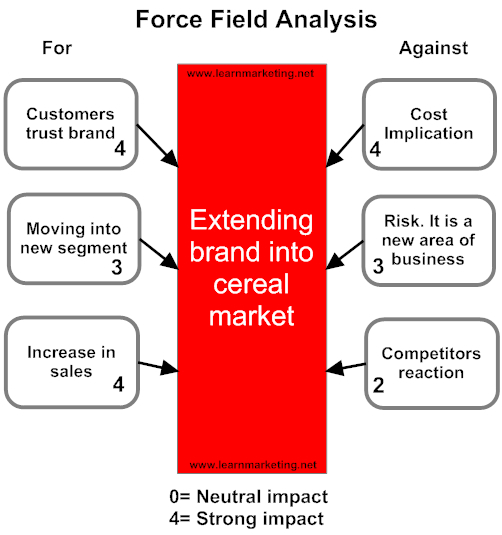
Force Field Analysis was developed by an American social psychologist named Kurt Lewin using Force Field Diagrams. According Kurt Lewis “an issue is held in balance by interaction of two opposing sets of forces- those seeking to promote change (driving forces) and those attempting to maintain the status quo (restraining forces)”. For any individual or organization, driving forces must be higher than restrictive/preventive forces for the change to happen.
Evaluating, analyzing and identifying the various forces that are involved in an issue is the main task of force-field analysis, and this is why this method is used. By identifying the positive and negative forces, it helps an organization by providing with the alternatives to take the decisions towards the desired change, so that the organization can fill up the gaps in the change process and successfully implement the strategy.


Change Kaleidoscope of Hewlett-Packard at the time of Meg Whitman's arrival.


References

·         About value based management, 2013.[online] force field analysis and diagram- Kurt Lewin [Accessed 3rd April 2013]

·         About Thompson, C., 2013. Expect HP revenue growth in 2014 [online] Available at: <http://www.cnbc.com/id/100484758 > [Accessed 3rd April 2013]
·          About Proworkproject,. Change kaleidoscope. [online] Available at: <http://www.proworkproject.com/prowork/change-kaleidoscope.html  > [Accessed 3rd April 2013]
·         About mind tools, 2010. force field analysis. [online] Available at: < http://www.mindtools.com/pages/article/newTED_06.htm > [Accessed 3rd April 2013]
·         About Mickey,J,. 2013. Strategic Change Context using a change kaleidoscope and force-field analysis[online] Available at: < http://www.kenyaplex.com/resources/7361-strategic-change-context-using-a-change-kaleidoscope-and-force-field-analysis.aspx > [Accessed 3rd April 2013]  

Wednesday, March 27, 2013

Week 17


Can you think of an organization that has implemented a ‘high risk strategy’ that has resulted in success (why was it high risk at the time and why was it a success- was it good luck or good judgment)?

As the term itself suggests, “High risk strategy” can be very fruitful as well as dangerous for any organization. Many organizations have implemented the “high risk strategy”, and wall-mart is also one of them. ”High-risk strategy” resulted to be a fruitful strategy for them.


Image source: http://graphics8.nytimes.com/images/2007/04/20/timestopics/walmart.topic.395/walmart.topic.395-sfSpan.jpg

In 1962, Sam Walton opened the very first store of wall-mart in Arkansas. It raised to a total of 25 stores in five years’ time and garnering a total revenue of USD 12.6 million. Under the CEO H Lee Scott Jr., wall-mart started to integrate its business internationally too. As a result, Bharti wall-mart private limited was announced by Bharti enterprises and wall-mart as their joint collaboration in August 2007. Currently it is serving a market clients of 176 million every year and has its stores quantity to 1800 with employees and associates more than 2 million and club setting in 15 markets.

It was a high risk strategy at that moment because no one have had tried to serve products to the consumers like wall-mart was willing to do. But, wall-mart rise as a perfect example of “high-risk strategy” being a success. It was a case of good judgment too. Why was “high-risk strategy” by wall-mark a success? And why it was a case of good judgment can be found out with the help of below points:-

Wall-Mart strategy (Which is Successful):

·         Bargaining power over suppliers.
·         Predicting demand for optimization of cost.
·         Information Technology usage in all business areas.
·         Getting new market opportunities through world-wide expansion.
·         Supply-chain management and logistics successful utilization.
·         In USA market, it is the largest importer of Chinese consumer goods.
·         Very high operational efficiency.
·         Making same profits like other competitors even by providing goods in 2-3 percent lower prices than others.

Partnership:

· Strategic partnership with various Chinese firms and P & G for consultancies regarding sustainable business.
· Partnership with Environmental defense fund and CRM to implement sustainability in International business. 
·  Partnership with hospitals to earn goodwill that they can provide and speedily expand its stores.

Vision and Mission:

·    Profit earning (huge) but also satisfying and maintaining customers.
·   To help the customers to maintain quality of life and live better by saving the customers money.
·  Providing goods and services from top quality groceries, school supplies to household items which are of low prices but best quality.

Price is not the only attribute that wall-mart excels on, but also selections, availability, quality and on time delivery that their competitors cannot compete. Wall-mart Company is now bigger than 160 nations with the revenue of USD 404.16 billion. This tells us how successful this company is, and how well it implemented “high-risk strategy”.


Now, do the same for an organization who embarked in a high risk strategy that resulted in some sort of failure (why was it high risk and why did it fail – bad luck or poor judgment)?

As the term itself suggests, “High risk strategy” can be very fruitful as well as dangerous for any organization. Many organizations have implemented the “high risk strategy”, and British Broadcasting Corporation is also one of them. ”High-risk strategy” resulted to be a failure for them.

Image source: http://24.media.tumblr.com/tumblr_m34e7smp1l1qhrkl4o1_500.jpg

British Broadcasting Corporation is a British public service broadcasting corporation. Providing impartial public service broadcasting in the United Kingdom, Isle of Man, and the Channel Islands is its main responsibility. Funds are generated through its profit-making activities and from the levy of TV license fees. BBC Trust supervises BBC and its management is not intervened by government.

Why was it high risk and why did it fail?

Coming out as inflexible and bureaucratic became the main risk factors for the company. BBCs choice of adapting as a commissioning model showed that BBC is less of the programmer and more of the designer of programs made by independent production house, which has been seen in recent years. Though, these two differs in terms of skills and structural culture.

“Inbuilt Creativity” is one of the many advantages that BBC possessed, but the essential element started to reduce and became marginalized. Characterized by strong values surrounding the public service ethos, BBC has always been traditionally run under a hierarchical and bureaucratic structure. Also, the carry outs were also been changed regularly. Eventually, BBC was revealing to be lacking of customer focus, elitist and more importantly expensive. The criticism forced BBC to perform an Organizational reorganization comprising the authorization of a commissioning form. This move resulted in loss of key talents from many useful functional areas of the firm.

There occurred the situations where the commissioning model were in dilemma on broadcasting the types of programs that the viewers would like. There was a clear threat for the firm from other competitor 200+ channels for their survival. It was a really big task for BBC to even survive in the competition but the increasing prices of broadcasting costs and for new talents made it even worse.

Therefore, BBC can be considered to be an example of an organization who embarked in a high risk strategy that resulted in some sort of failure. It is a pure case of poor judgment, and it couldn’t adapt itself with the changing demand and taste of its viewers and couldn’t make proper strategies.


Reference:
About Wall-mart, [Online],  www.usanfranonline.com › Online Education Resources accessed on 25th March 2013
About Wall-mart, [Online],  www.nytimes.com/packages/pdf/business/26walmart.pdf accessed on 25th March 2013

About Wall-mart, [Online], www.perishablepundit.com/index.php?date=09/20/07&pundit=1accessed on 25th March 2013

About Wall-mart strategy, [Online], zenith-consulting.com/research/walMart/Wal-Mart-Strategy.pdfaccessed on 26th March 2013

About British Broadcasting Corporation, [Online], http://ivythesis.typepad.com/term_paper_topics/2009/09/case-study-british-broadcasting-corporation.html#ixzz2AuIDRkjN accessed on 26th March 2013

Friday, March 22, 2013

Week 16

1) In your own words and using referenced quotes describe the difference between organic growth, merger and acquisition and strategic alliance.


Organic Growth

The strategy that the company uses to expand its business through the use of its own assets and resources is known as Organic growth strategy. “Do It Yourself” is the strategy that is followed by Organic growth. It allows the companies to set and achieve corporate goals in which ever manner they choose to. Quality, PR, headcount and revenue are the four main pillars upon which Organic growth strategies are built.
Organic growth strategies are used by many well-known public companies. Tiffany and company, Outback Steak House and Best Buy are some of them.

The key advantages of organic growth are as follows:-
·         Strategic independence.
·         No availability constraints.
·         Spreading investment over time.
·         Knowledge and learning can be enhanced.


Mergers and Acquisitions:

Mergers and Acquisitions (M&A) is a process of selling, buying, combining & driving of similar entities and different companies so that rapid growth can be achieved in new location or new field, or in the location of its origin or in its sector, without the need of using a joint venture or creating other child entity or subsidiary.

Merger: Integration of stock management, operation and everything else between two companies.

Acquisition: One company buys another company & become one.

The companies to follow this strategy are driven by three strategic motives. They are;

·         Strategic motive (extension, consolidation and capabilities)
·         Managerial motive (Personal ambition, Bandwagon effects)
·         Financial motive (financial efficiency, tax efficiency and assets stripping or unbundling )


Strategic Alliance

Strategic alliance is an agreement made by two companies deciding to share resources for undertaking a specific agreement for the mutual benefits. Strategic alliance lies between organic growth and merger and acquisition (M&A). Equity and non-equity alliance are the two main kinds of ownerships found in strategic alliance. Equity alliances involves the creation of a new entity that is owned separately by the partners involved. Example, Microsoft and Nokia. And, non-equity alliances are typically looser, without the commitment implied by ownership. Examples can be Renault as being a strategic investor in Nissan.

Purposes for Strategic alliances:

·         A complementary alliance is another motive for strategic alliances. It brings together matching strengths to counteract the other partner’s weaknesses.
·         The need for critical mass is the major motives for strategic alliance. It can be achieved by forming partnerships either with the competitors or suppliers of the raw materials. This may drive towards cost reduction, sharing risks and improved customer offering.
·         Co-specialization allows each partner to work and activities that best suit their capabilities. For instance, alliance is widely used when an organization enters into a new market with different geographical characteristics. Now, the company needs local knowledge and knowledge about distribution, marketing, advertising and customer support.

The differences between organic growth, merger and acquisition and strategic alliance are:

1)      Organic growth will be the best strategy if an organization is willing to develop in new venture units. Strategic alliance will be best if the organization has the ability to alliance with relevant partner unit. But in acquisition organization might feel difficulties in buying the whole organization.
2)      Organic growth strategy makes the internal development of organization very slow. Development of capabilities might be outdated because of lack of experience and marketing skills.
Where as in alliance, the development process is better than organic growth, on the contrary,                              acquisition is the quickest method of strategy development.
3)      Organic growth best work with soft resources rather than hard resources. There will be a cultural consistency because the capabilities are developed with an organization. Acquisition best work with hard resources and cultural and valuation problems may arise. Strategic alliance may face difficulties like culture and control problems.


2) Give an example of a company that has grown through a) organic growth, b) merger or acquisition and c) strategic alliance.


Organic Growth

Bibby Line Group is a company which has got the growth through Organic growth. This group is characterized by organic growth. At the beginning of its start in the nineteenth century, it started with just seven ships and over the next 20 years it expanded to acquire another 18 vessels. Originally, Mediterranean ports were its focused routes but as the expansion came it began to support trade with China, India and later in South America. The Bibby Line Group Ships carried variety of cargos from animal hides, sugar, cotton and many other commodities.


Image Source: http://www.charitiestrust.org.uk/wp-content/uploads/2012/10/27dc-bibby-img-png.png


Strategic Alliance

Nokia and Microsoft are the two companies that have gone through the strategic alliance. On 11th February 2011, they declared their plans to form a broad strategic partnership that would use their expertise and complementary strengths to create a new global mobile ecosystem. They intend to mutually create market-leading mobile products and services designed to offer developers, operators and customer’s unrivaled opportunity and choice. The partnership would create the opportunity for rapid time to market execution because each company would be focusing on its core competencies.


 Image Source: http://www.digitaltrends.com/wp-content/uploads/2011/02/nokia-plan-to-move-forward-stephen-elop-steve-ballmer.jpg


Merger and Acquisition

The best example for Merger & Acquisition (M&A) of Sony Corporation and Ericsson.
Merging of Sony Corporation and Ericsson and becoming Sony Ericsson in October 1, 2001.


Image source: http://cdn.ausdroid.net/wp-content/uploads/2011/10/Sony-Ericsson-Buyout.jpg

The Acquisition of Ericsson’s share by Sony Corporation becoming Sony Mobile Communication in February 16, 2012 can be the best example of Acquisition.

Images source: http://www.houseofjapan.com/electronics/sony-finalizes-divorce-with-ericsson-renames-itself-sony-mobile-communications


3. Briefly discuss the merger between Britvic and AG Barr. What advice would you give to the new board?


The new company “Barr Britvic Soft Drinks PLC” was founded after two separate companies “AG Barr” and “Britvic” merged together to be one. Britvic shareholders hold 63% of shares and AG Barr shareholders holds the remaining 37% shares.

The merger strategies have brings many positive aspects to the company and some of them are:
·         Loyal customers of both the company will be buying the products of the newly merged company. There is a high chance of shift from some other brand to the company’s brand.
·         With the combination, there will be better chance for the company to compete with Coke by entering in some new market and thus gaining market shares.
·         The newly combine company will be benefited from the economy of the scale.
·         The cost reduction is very effective especially in difficult or strong markets because AG Barr is strong in certain market which now will help for Britvic to go in that market and vice versa.


The potential risk of merger between Britvic and Barr are:

·         Britvic’s half of the turnover comes from a low margin bottling hence, merger with Barr may not have helped Britvic to resolve their problems.
·         The customer dissatisfaction for one product has negative impact on another product. For instance, if a loyal customer of Barr has a bad experience with the service or products of Britvic, then the customer may shift from Barr to other brand as Barr and Britvic are combined. Hence, there is a high chance of customers shifting to another brand because of their customers’ dissatisfaction.
·         Britvic’s half of the turnover comes from a low margin bottling hence, merger with Barr may not have helped Britvic to resolve their problems.


Advice and suggestion to the new board:

·         The investment should be increase in order to gain the quick market share and unnecessary expenses should be cutoff.
·         There should be equal support and coordination among the staffs and board members for the new brand.
·         The flow of communication must be effective and the whole company should have common vision and strategy.


References

·         Online available from http://www.business-sale.com/expanding-your-business-through-m-and-a.html  [Accessed March 21, 2013]
·         Johnson, Whittington and Scholes (2011) Exploring Strategy, 9th Edition, Pearson Education, Chapter 10
·         Johnson, Whittington and Scholes (2011) Exploring Strategy, 9th Edition, Pearson Education, Chapter 6
·         Online available from http://executiveeducation.wharton.upenn.edu/ . [Accessed March 21, 2013]


·